
Technical guides
What Is Solvent Recovery? Methods and Choosing the Right System
Solvent recovery is the capture and purification of solvent that is used in industrial production and would otherwise evaporate to the atmosphere or be discarded as contaminated waste, so that it can be used again. It addresses two problems at once: it lowers volatile organic compound emissions and it cuts solvent purchasing costs. Which method is right depends on whether the solvent is lost in the air or in liquid waste.
Starting point
Where is solvent lost in a plant?
On a printing, laminating or coating line solvent is lost in two ways, and the two call for different solutions.
Loss in the vapour phase. The job of the solvent in an ink, lacquer or adhesive is to carry the material onto the surface and then get out of the way. It evaporates in the drying oven and is discharged through the stack with the exhaust air. Most of the solvent entering the line leaves this way.
Loss in the liquid phase. Solvent used to clean machines, rollers, pumps and containers becomes contaminated with paint and resin. After a while it loses its cleaning power and is set aside as waste. The quantity is smaller, but because it is disposed of as hazardous waste the cost is high.
Before choosing a recovery method, the size of these two streams should be measured. Most plants need a separate solution for each, and the two solutions share the same storage and automation infrastructure.
Methods
Four methods compared
| Method | How does it work? | Does it return the solvent? | Best suited to | Its limit |
|---|---|---|---|---|
| Activated carbon adsorption | Solvent-laden air passes through an activated carbon bed, the solvent is held in the pores, and the bed is heated to recover it | Yes | Continuous, high-flow solvent-laden air; valuable solvent | Design becomes difficult with multi-component solvents or solvents that react with carbon |
| Distillation | Dirty liquid solvent is evaporated and condensed; the residue stays in the still | Yes | Contaminated liquid solvent; separating mixtures into their components | Not applicable to solvent in air; with azeotropes the water is not fully removed |
| Condensation | Solvent-laden air is cooled and the solvent liquefied | Yes | Low flow, very high concentration | Dilute exhaust needs very low temperatures; may not meet the emission limit on its own |
| Thermal oxidation | The solvent is burned at high temperature into carbon dioxide and water | No | Solvents that are worthless, very mixed or uneconomic to recover | The solvent is destroyed; support fuel may be needed |
For the place of these methods among the best available techniques see the STS BREF[R-04].
Assessment
When does activated carbon adsorption come to the fore?
Oxidation solves the emission problem but destroys the solvent. The plant keeps buying the same solvent again. If the solvent is expensive and tonnes of it are consumed every day, what goes out of the stack is in fact raw material.
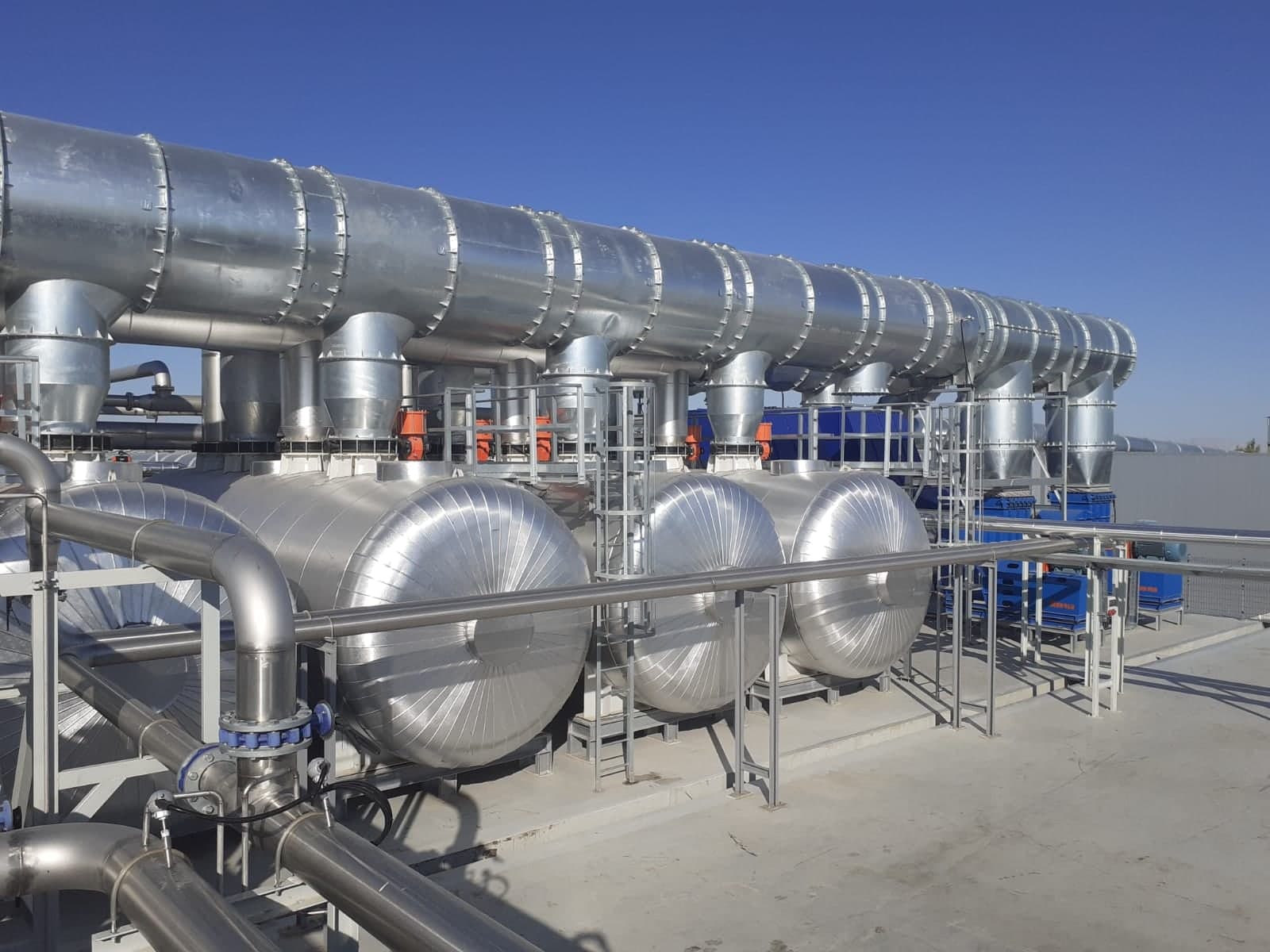
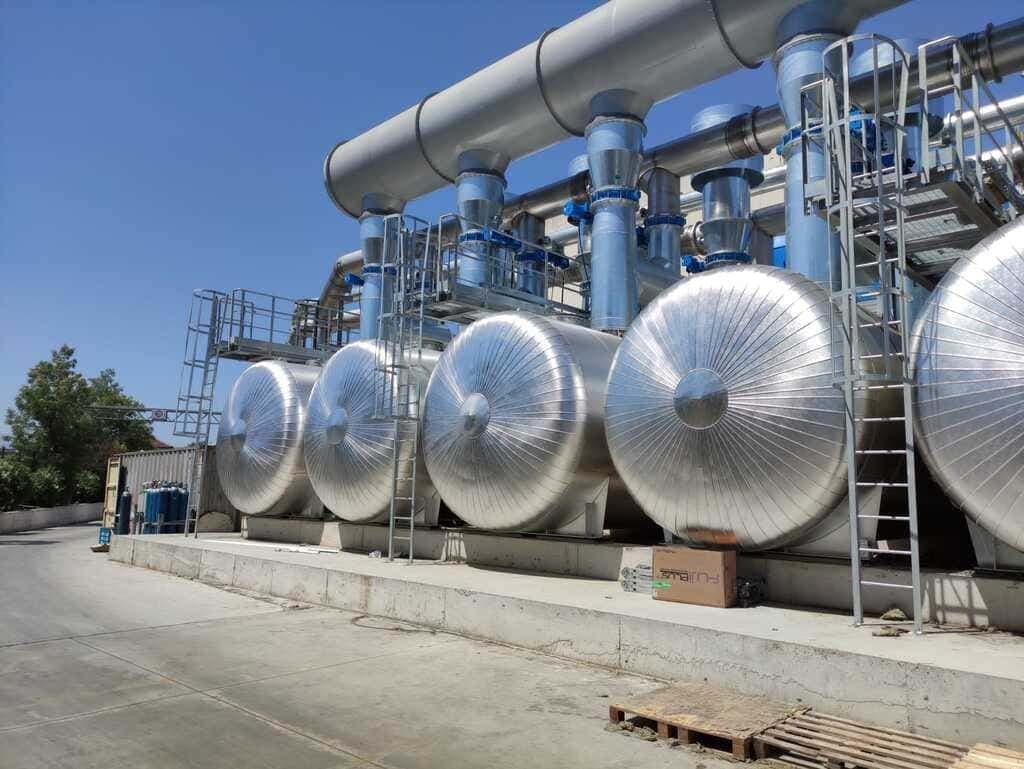
Activated carbon is a flexible adsorbent in terms of pore size, pore distribution and quantity. It can be adapted to the recovery of solvents with different boiling points and chemical structures[C-01]. That is why it is the most widespread recovery method on flexible packaging, printing, adhesive tape and coating lines.
Decision matrix
Which system comes into play in which situation?
The rows show typical situations encountered in a plant, the columns show the systems. The matrix is a first orientation.
| Situation on site | Activated carbon adsorption | Distillation | Molecular sieve | Thermal oxidation | Closed-loop storage |
|---|---|---|---|---|---|
| Continuous solvent-laden air in the dryer exhaust; a valuable solvent that does not mix with water (toluene, hexane) | ● Main solution | – Not applicableA decanter is sufficient | – Not applicable | – Not applicableDestroys the solvent | ○ ComplementaryStorage of the recovered solvent |
| A water-miscible solvent or mixture in the dryer exhaust (ethyl acetate, alcohols) | ● Main solution | ● Main solutionSeparation of components and water | ○ ComplementaryFor the water distillation cannot reach | – Not applicableDestroys the solvent | ○ Complementary |
| Liquid solvent from cleaning, contaminated with paint and resin | – Not applicableUsed for solvent in air | ● Main solution | ○ ComplementaryIf there is a water target | – Not applicable | ○ Complementary |
| Water content of the recovered solvent too high for printing or coating | – Not applicable | ○ ComplementaryDown to the azeotrope | ● Main solution | – Not applicable | – Not applicable |
| Worthless or multi-component exhaust that is uneconomic to separate | – Not applicableMay not be economic | – Not applicable | – Not applicable | ● Main solutionRemoves the emission, the solvent does not return | – Not applicable |
| Vapour loss and fire risk while storing solvent and feeding it to the line | – Not applicable | – Not applicable | – Not applicable | – Not applicable | ● Main solutionNitrogen-blanketed tank and closed transfer |
This matrix is a general orientation; it is not a proposal or an engineering result. The final system selection is made for each project after a site survey, air measurement and solvent analysis. Thermal oxidation is included for comparison.[R-04]
Decision guide
How is the right system chosen?
The five questions below summarise what we ask during the survey meeting.
- DurumIs the loss in the air or in liquid waste?
- Air calls for adsorption, liquid for distillation. In many plants the two are installed together.
- DurumDoes the solvent mix with water?
- Toluene and hexane do not; they separate in a decanter after condensation.[D-01] Ethyl acetate and alcohols do; they need dehydration by distillation and a molecular sieve.[D-02]
- DurumHow dilute is the exhaust?
- The more dilute the exhaust, the larger the plant. If the concentration can be raised safely with L.E.L. control, the plant gets smaller and the dryers’ energy consumption falls too.
- DurumWhat are the annual consumption and the price of the solvent?
- As consumption and price rise, the value of the recovered solvent rises and the payback period shortens. The calculation should be made with the plant’s own data.
- DurumAre the site and utilities suitable?
- Modular packaged units are preferred where space is limited, site-built plants where space is ample. Steam, cooling water and nitrogen capacity affect the design.
The big picture
How does recovered solvent return to production?
In a well-designed system the solvent circulates within the plant in a closed loop without touching the atmosphere.
Capture
The solvent in the dryer exhaust is captured and liquefied in the adsorption plant.
Purification
Solvents that do not mix with water are separated in a decanter. Water-miscible solvents go through distillation and, if needed, a molecular sieve.
Storage
Clean solvent is taken into nitrogen-blanketed tanks; it does not pick up moisture and does not evaporate.
Feedback
The solvent is pumped to the ink kitchen or the coating preparation area. Purchased fresh solvent only makes up the losses.
Processing of dirty solvent
Dirty solvent from cleaning is collected in a separate tank, purified by distillation and joins the same loop.
Regulation
Is recovery a choice or an obligation?
Air emissions from plants that use solvents are subject to permits. In the European Union the framework is set by the Industrial Emissions Directive;[R-01] the best available techniques for surface treatment using organic solvents are defined in a separate decision.[R-03] In Türkiye the Regulation on the Control of Industrial Air Pollution [R-06]and the Regulation on the Management of Industrial Emissions, in force since 1 December 2025,[R-07] apply.
The regulations require emissions to be limited; the plant chooses the method. Recovery is the option that turns this obligation from a cost item into a raw-material saving. Which limit value applies to your plant is determined by your environmental consultant and your permit conditions.
Frequently asked questions
Frequently asked questions
In which industries is solvent recovery used?
Solvent recovery is used most in flexible packaging, rotogravure and flexo printing, adhesive tape, film, foil and paper coating, synthetic leather, chemicals and pharmaceuticals.
What is the difference between solvent recovery and thermal oxidation?
Thermal oxidation destroys the solvent by burning it and solves only the emission problem. Solvent recovery captures the solvent and makes it reusable, lowering both emissions and solvent costs.
What is the first step towards a recovery plant?
The first step is a site survey. Air flow, solvent type and consumption are measured, then a feasibility study and a proposal are prepared.
Can every solvent be recovered?
Technically most industrial solvents can be recovered. Whether it is economic depends on the price of the solvent, the quantity consumed and how complex the mixture is. For worthless or multi-component streams oxidation may be the better choice.
Sources and method
What the information on this page rests on
This page was prepared by Yeşil Çevre Makine using the company’s product catalogue, photographs from its site installations and the public sources listed below. Information that is a company statement is marked as such in the text. Project-specific values (capacity, emission, recovered quantity) are determined for each plant at the survey and design stage.
Official regulation and standards
Primary sources; links go to the official publication pages.
- R-01Directive 2010/75/EU on industrial emissions (konsolide metin, 4 Ağustos 2024)Avrupa Birliği, EUR-Lex · 24 Kasım 2010; konsolide 4 Ağustos 2024 · Accessed: 18 Eylül 2026 · 1999/13/EC sayılı solvent emisyon direktifini 7 Ocak 2014 itibarıyla yürürlükten kaldırmıştır
- R-03Commission Implementing Decision (EU) 2020/2009: organik solventlerle yüzey işlem için MET (BAT) sonuçlarıAvrupa Komisyonu, EUR-Lex · 22 Haziran 2020; Resmî Gazete 9 Aralık 2020 · Accessed: 18 Eylül 2026
- R-04Best Available Techniques (BAT) Reference Document on Surface Treatment Using Organic Solvents (STS BREF)Avrupa Komisyonu Ortak Araştırma Merkezi (JRC) · 2020 · Accessed: 18 Eylül 2026
- R-06Sanayi Kaynaklı Hava Kirliliğinin Kontrolü YönetmeliğiT.C. Çevre, Şehircilik ve İklim Değişikliği Bakanlığı, Mevzuat Bilgi Sistemi · Resmî Gazete 3 Temmuz 2009, sayı 27277 · Accessed: 18 Eylül 2026
- R-07Endüstriyel Emisyonların Yönetimi YönetmeliğiT.C. Çevre, Şehircilik ve İklim Değişikliği Bakanlığı · Resmî Gazete 14 Ocak 2025, sayı 32782; yürürlük 1 Aralık 2025 · Accessed: 18 Eylül 2026
Technical reference data
Public data sources used for solvent properties.
- D-01NIOSH Pocket Guide to Chemical Hazards: TolueneABD Hastalık Kontrol ve Korunma Merkezleri (CDC), NIOSH · Son gözden geçirme 30 Ekim 2019 · Accessed: 18 Eylül 2026
- D-02NIOSH Pocket Guide to Chemical Hazards: Ethyl acetateCDC, NIOSH · Son gözden geçirme 30 Ekim 2019 · Accessed: 18 Eylül 2026
Company statements and documents
Statements resting on these sources are Yeşil Çevre Makine’s own; they have not been verified by an independent body.
- C-01V.O.C. Solvent Geri Kazanım Tesisleri kataloğu (Türkçe)Yeşil Çevre Makine · 2022 · Accessed: 18 Eylül 2026 · Şirket belgesi
Request a site survey and pre-feasibility for your line
Tell us the solvent, the approximate consumption and the line. Our engineers call you to clarify the need and, where useful, plan on-site measurements.
What we ask for
- Solvent type
- Consumption or air flow
- Sector and line type
- Project stage
To reach us directly: +90 506 839 88 57 · info@yesilcevmak.com