
Product and process
Solvent Distillation Unit
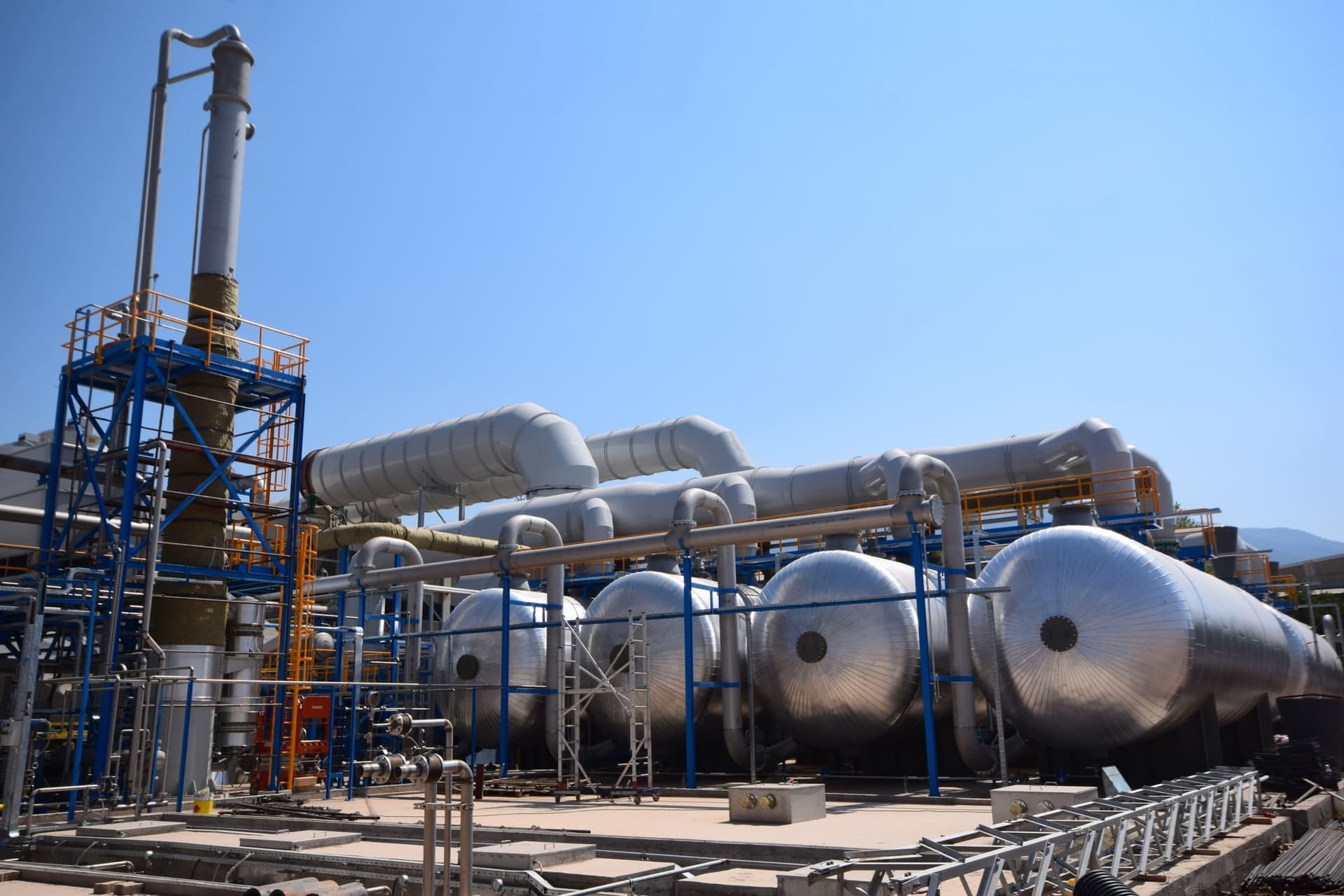
A solvent distillation unit purifies solvent that is contaminated with paint, ink and resin, or mixed with water and other solvents, by evaporating and re-condensing it. Yeşil Çevre Makine designs, manufactures and commissions vacuum batch units and continuous distillation columns, from the recovery of washing solvents to the separation of multi-solvent mixtures in recovery plants.
Summary
Distillation solves three different problems
Dirty solvent: solvent used to clean machines, cylinders and containers becomes contaminated with paint and resin. Distillation leaves the contamination in the still and returns clean solvent.
Wet solvent: in activated-carbon recovery plants water-miscible solvents condense together with water. Distillation removes most of the water.
Mixed solvent: on multi-colour printing lines several solvents are recovered together. A distillation column separates the components by boiling point.
Working principle
How does solvent recovery by distillation work?
Feed
Dirty or mixed solvent is transferred from the feed tank to the still. In continuous systems the feed rate is controlled automatically.
Evaporation
The still is heated indirectly with thermal oil or steam; no flame touches the solvent. The solvent evaporates; paint, resin, pigment and other solids stay in the still.
Separation
For multi-component mixtures the vapour passes through a distillation column. The contact surfaces in the column enrich the lower-boiling component at the top and the higher-boiling one at the bottom.
Condensation
The solvent vapour is liquefied in the condenser with cooling water. Non-condensable gases are vented safely.
Product and residue
Clean solvent goes to the storage tank. The residue collected in the still is drained under control at the end of the cycle and sent to licensed disposal.
Comparison
Atmospheric distillation versus vacuum distillation
| Criterion | Atmospheric distillation | Vacuum distillation |
|---|---|---|
| Boiling temperature | The solvent’s normal boiling point | Markedly lower |
| High-boiling solvents | Need a high heating temperature and a long cycle | Can be processed at a lower temperature |
| Risk of thermal degradation | Higher for heat-sensitive solvents and residues | Lower |
| Working with flammable solvent | Higher surface temperatures | Lower surface temperatures |
| Equipment | Simpler | Needs a vacuum pump, sealing and a vacuum-rated vessel |
| Suited to | Low-boiling, heat-resistant solvents | High-boiling or heat-sensitive solvents; lines where energy consumption is critical |
Our units are designed to work under vacuum; the operating pressure is set in the project according to the solvent’s properties.
Applications
The distillation solution by type of feed
| Feed | Typical source | Purpose | Suitable structure |
|---|---|---|---|
| Washing solvent contaminated with paint and ink | Cleaning on printing, paint and coating lines | Removal of solids and resin | Batch still, vacuum |
| Recovered solvent containing water | Outlet of a V.O.C. recovery plant | Water removal | Continuous column; then a molecular sieve |
| Multi-solvent mixture | Multi-colour printing, lamination | Separation into components | Continuous, multi-stage column |
| Process residue solvent | Coating, adhesive and resin production | Recovery and waste reduction | Batch or continuous, depending on the residue |
| Process-specific solvents | Chemicals and pharmaceuticals | Recovery at the required purity | Project-specific column design |
Selection guide
Batch unit or continuous column?
The right structure depends on the daily quantity, how variable the feed is, and the target purity.
- DurumIf the daily quantity of dirty solvent is limited and the feed varies from batch to batch
- A batch unit fits. Each batch is processed separately and the still is drained at the end of the cycle. Operation is simple.
- DurumIf the solvent arrives continuously and at a high rate, for example from the outlet of a recovery plant
- A continuous column fits. A steady feed gives steady product quality and lower energy consumption per unit.
- DurumIf the boiling points of the solvents in the mixture are close together
- A column with many stages is needed. A composition analysis of the mixture is essential for the column design.
- DurumIf the solvent forms an azeotrope with water
- Distillation alone is not enough; a certain water content cannot be reached. The line is completed with a molecular sieve.
- DurumIf the residue is sticky, resinous or prone to polymerisation
- The still geometry, agitation and draining arrangement are designed accordingly; otherwise the still surface fouls and heat transfer drops.
Design
The inputs that set capacity and configuration
A distillation unit is not sized without a sample analysis. Two dirty solvents of the same volume produce very different cycle times and energy demands when their contamination level and composition differ.
- Daily quantity and operating hours: set the still volume and the batch-or-continuous choice.
- Solvent type and boiling range: set the operating pressure and heating medium.
- Contamination level and nature of the residue: set the still design, draining frequency and recovery rate.
- Target purity and water content: set the number of column stages and the need for a drying step.
- Heating and cooling sources: existing thermal oil, steam and cooling water capacity.
- Layout and hazardous-area zone: equipment selection and ventilation follow from these.
Construction and automation
What our units have in common
- Mode of operation
- Under vacuum; batch or continuous
- Heating
- Indirect heating with thermal oil or steam
- Materials
- Carbon steel, SS 304 or SS 316, depending on the chemistry of the solvent and residue[C-01]
- Automation
- Temperature, pressure and level controlled, PLC based; software and panel are prepared in-house[C-01]
- Safety
- Relief valves, over-temperature and level interlocks, equipment selected for the hazardous area
- Integration
- Runs under one automation system with the adsorption plant, molecular sieve and storage system
From the field
Distillation units and columns we have built
Site installations
Solvent distillation unit, site view 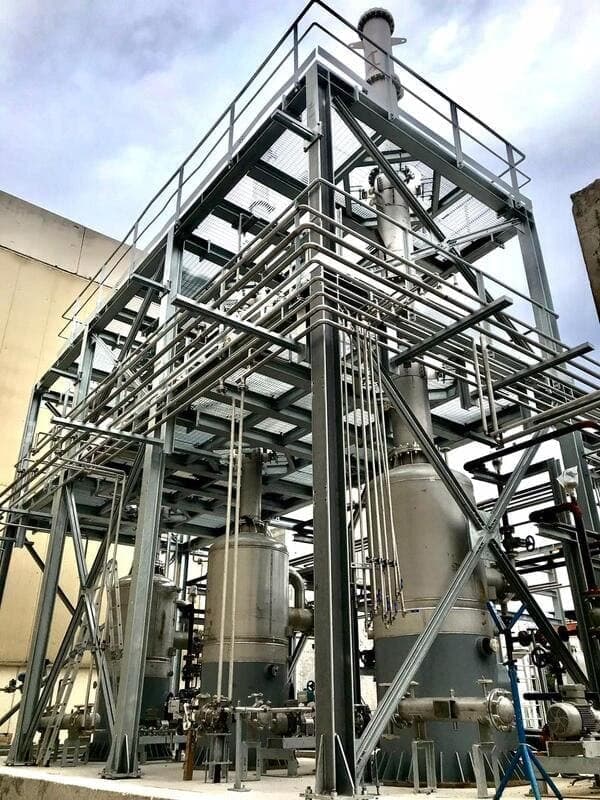
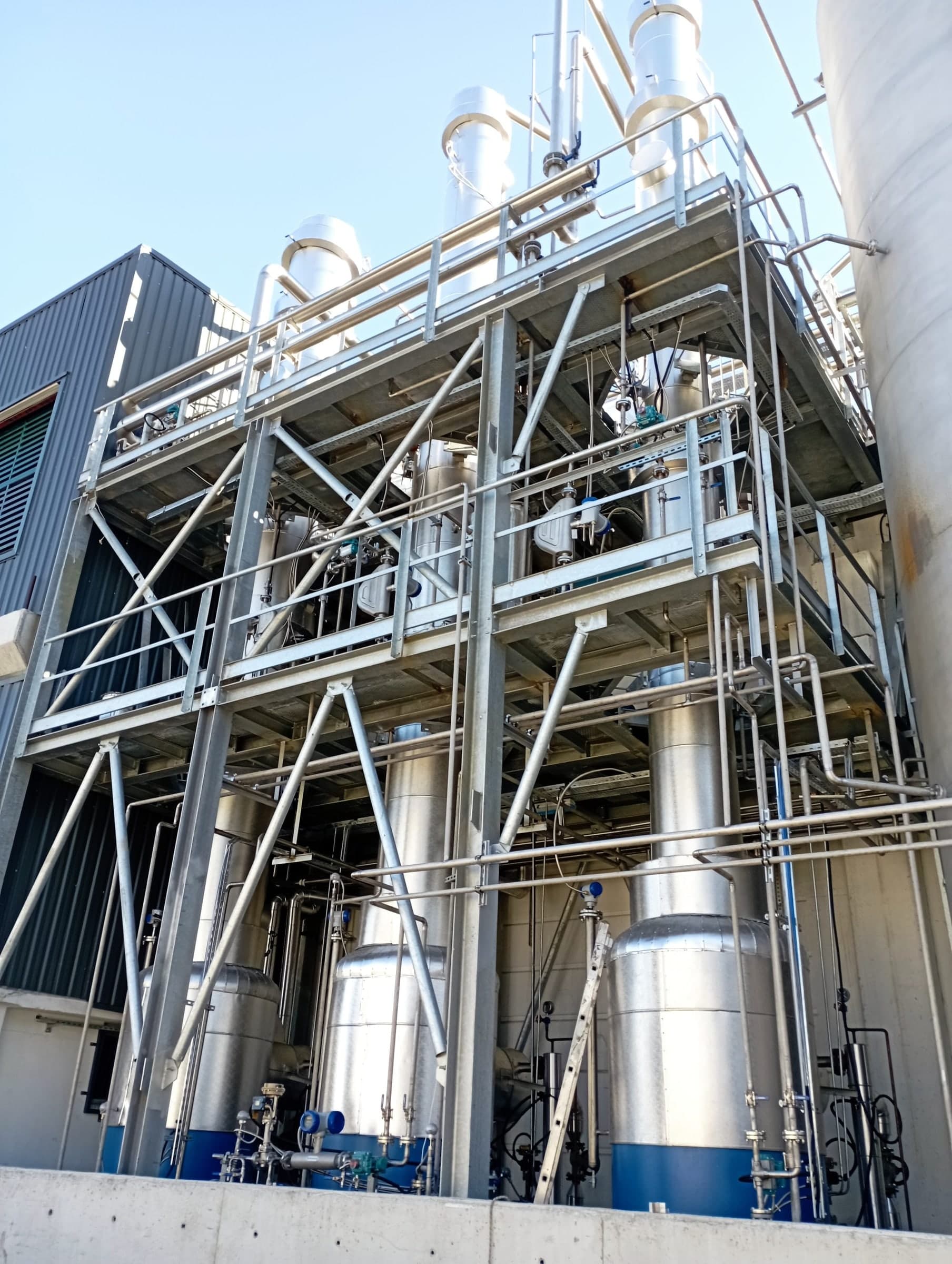
Distillation column and steel platform 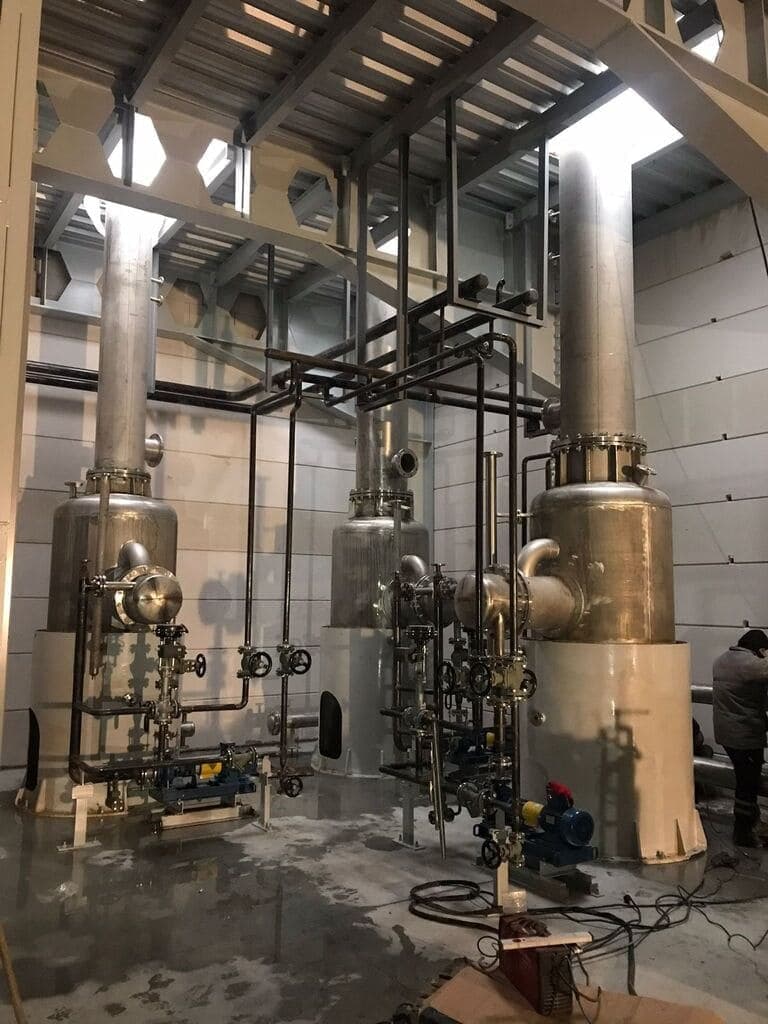
Distillation columns, indoor installation
Units and design
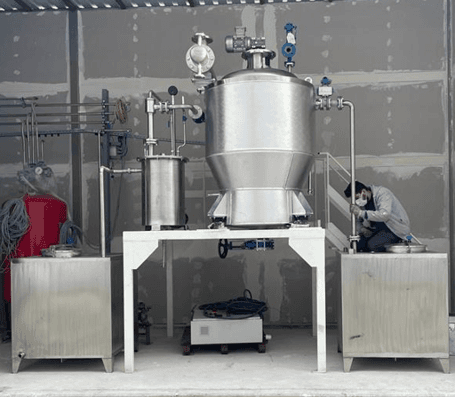
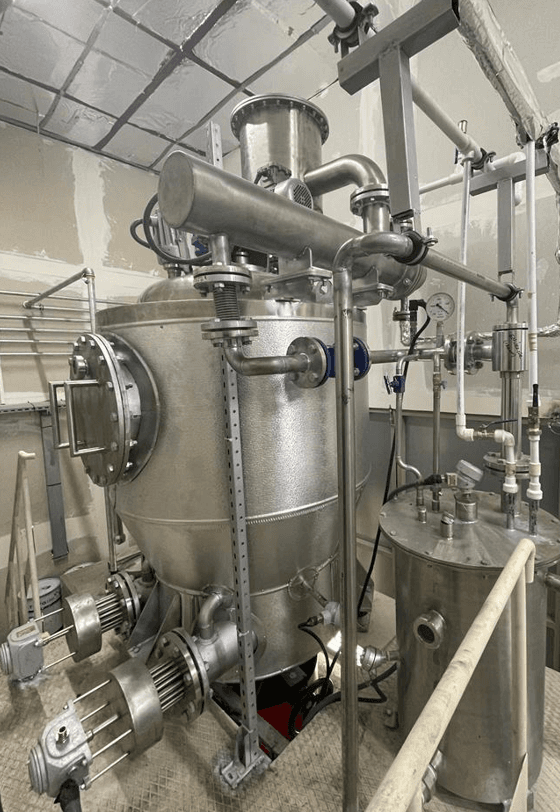
Solvent distillation unit, stainless steel still and tanks 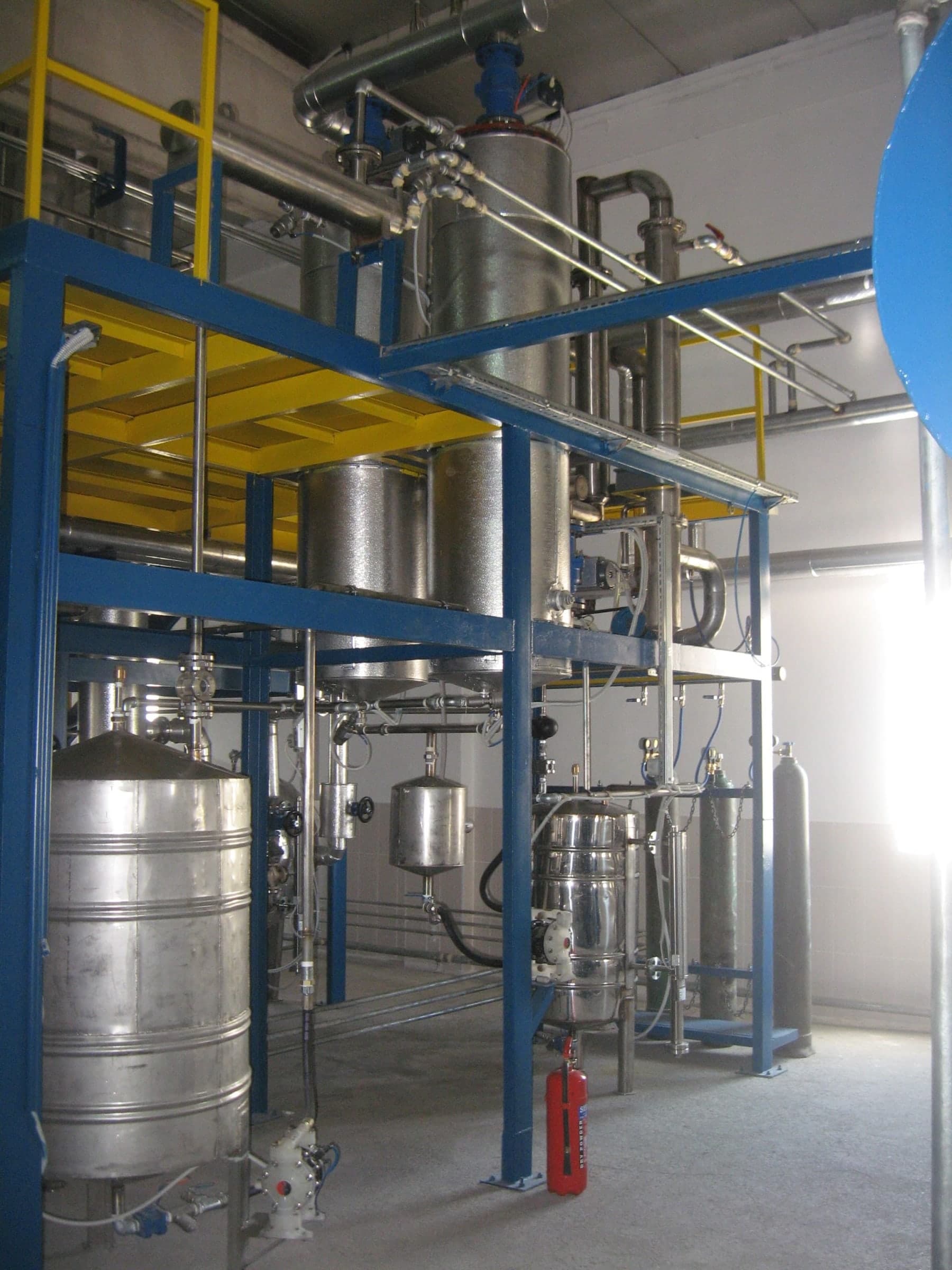
Molecular sieve and distillation unit platform 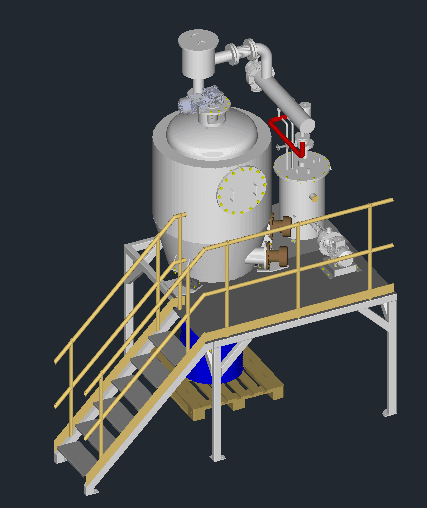
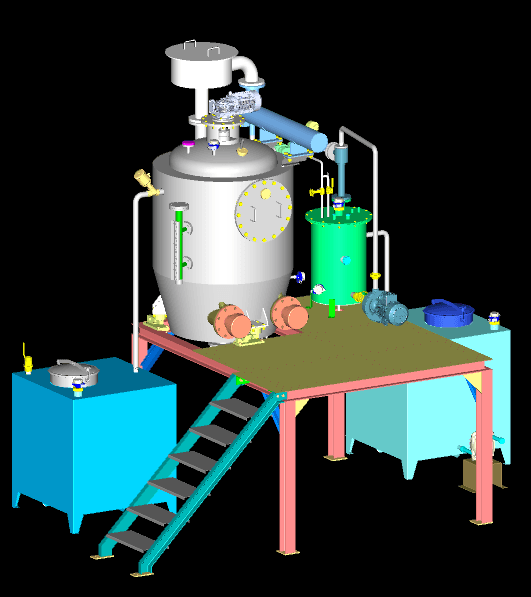
Three-dimensional design of a solvent distillation unit
The photographs show Yeşil Çevre Makine’s own installations and designs.
Frequently asked questions
Frequently asked questions about the solvent distillation unit
What does a solvent distillation unit do?
A solvent distillation unit evaporates contaminated solvent and re-condenses it, separating it from paint, ink, resin and other residues. The clean solvent is reused in production; both the solvent purchased and the waste sent for disposal decrease.
What is vacuum distillation and why is it preferred?
Vacuum distillation is distillation under reduced pressure. Because the solvent’s boiling point falls with pressure, the unit works at a lower temperature, the solvent does not degrade thermally, and flammable solvents are handled more safely.
Can mixtures of several solvents be separated?
Yes. Multi-solvent mixtures are separated in a distillation column using the difference in the components’ boiling points. The column is designed for each project from a composition analysis of the mixture.
How is the capacity of a distillation unit determined?
Capacity is determined by the daily quantity of dirty solvent, the solvent type, the contamination level and the operating hours. Yeşil Çevre Makine sizes the unit for your plant after a survey and sample analysis.
Does distillation remove water completely?
Not always. Some solvents, such as ethyl acetate and alcohols, form an azeotrope with water, and distillation cannot go below a certain water content. The remaining water is removed with a molecular sieve.
Sources and method
What the information on this page rests on
This page was prepared by Yeşil Çevre Makine using the company’s product catalogue, photographs from its site installations and the public sources listed below. Information that is a company statement is marked as such in the text. Project-specific values (capacity, emission, recovered quantity) are determined for each plant at the survey and design stage.
Company statements and documents
Statements resting on these sources are Yeşil Çevre Makine’s own; they have not been verified by an independent body.
- C-01V.O.C. Solvent Geri Kazanım Tesisleri kataloğu (Türkçe)Yeşil Çevre Makine · 2022 · Accessed: 18 Eylül 2026 · Şirket belgesi
Request a site survey and pre-feasibility for your line
Tell us the solvent, the approximate consumption and the line. Our engineers call you to clarify the need and, where useful, plan on-site measurements.
What we ask for
- Solvent type
- Consumption or air flow
- Sector and line type
- Project stage
To reach us directly: +90 506 839 88 57 · info@yesilcevmak.com