
Product and process
V.O.C. Solvent Recovery Plants
A V.O.C. solvent recovery plant captures the volatile organic compounds in the solvent-laden air leaving the drying ovens of printing, laminating and coating lines on activated-carbon beds, then heats the bed to return the solvent as liquid. Yeşil Çevre Makine designs, manufactures and installs these plants turnkey in Kemalpaşa, İzmir. Stack emissions fall and a large share of the purchased solvent goes back into production.
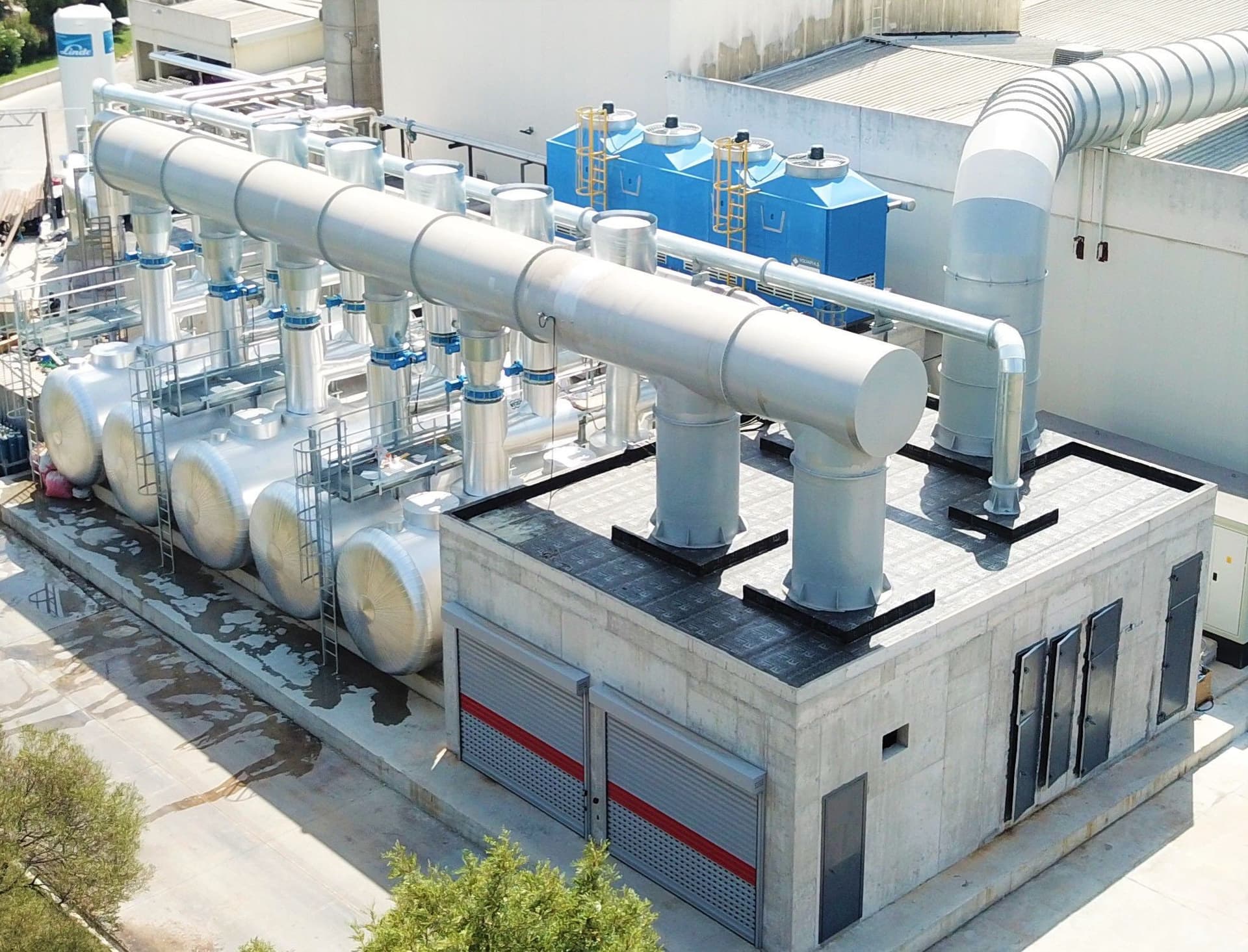
Quick facts
Technical summary
Process
- Method
- Activated-carbon adsorption and thermal regeneration
- Separation
- Condensation and decanter; distillation and molecular sieve for water-miscible solvents
- Scale
- Modular package units where space is tight; site-erected plants for high air flows
Scope and automation
Materials
- Materials of construction
- Carbon steel or stainless steel (SS 304, SS 316), chosen for the solvent and operating conditions[C-01]
Emissions
- Outlet emission
- The design target for solvent at the plant outlet is below 50 mg/Nm³[C-01]Company statement. The limit value and measurement conditions that apply to your plant are set in the project according to your environmental permit.
Air flow, number of adsorbers, carbon quantity and energy consumption are not catalogue values; they are calculated for each plant after on-site measurement.
Why recover
Burning the solvent solves the emission; recovering it also solves the cost
When the solvent is vented or incinerated
- Almost all of the solvent used on printing, laminating and coating lines evaporates in the drying oven. It does not stay in the product; it leaves with the exhaust air.
- Without abatement this is a direct volatile organic compound emission and is limited under the air emission permit.
- Incineration methods such as thermal oxidation remove the emission but destroy the solvent. The plant keeps buying the same solvent, and the oxidiser may need auxiliary fuel.
When the solvent is recovered on activated carbon
- The solvent comes back as product. Every kilogram recovered is a kilogram of raw material not purchased.
- Activated carbon is a flexible adsorbent in pore size, pore distribution and quantity; it can be matched to solvents with different boiling points and chemical structures[C-01].
- The European Union’s best available techniques document for surface treatment with organic solvents treats both adsorptive solvent recovery and oxidation as emission reduction techniques.[R-04] Which one is right depends on the solvent’s value, the make-up of the mixture and the air flow.
Process flow
Six steps from oven exhaust to storage tank
- Collection and pre-treatmentfilter, cooling
- Adsorptionactivated-carbon beds
- Regenerationthermal desorption
- Condensation and separationcondenser, decanter
- Purificationdistillation, molecular sieve
- Storage and returnnitrogen-blanketed tank
Step by step
How does recovery by activated-carbon adsorption work?
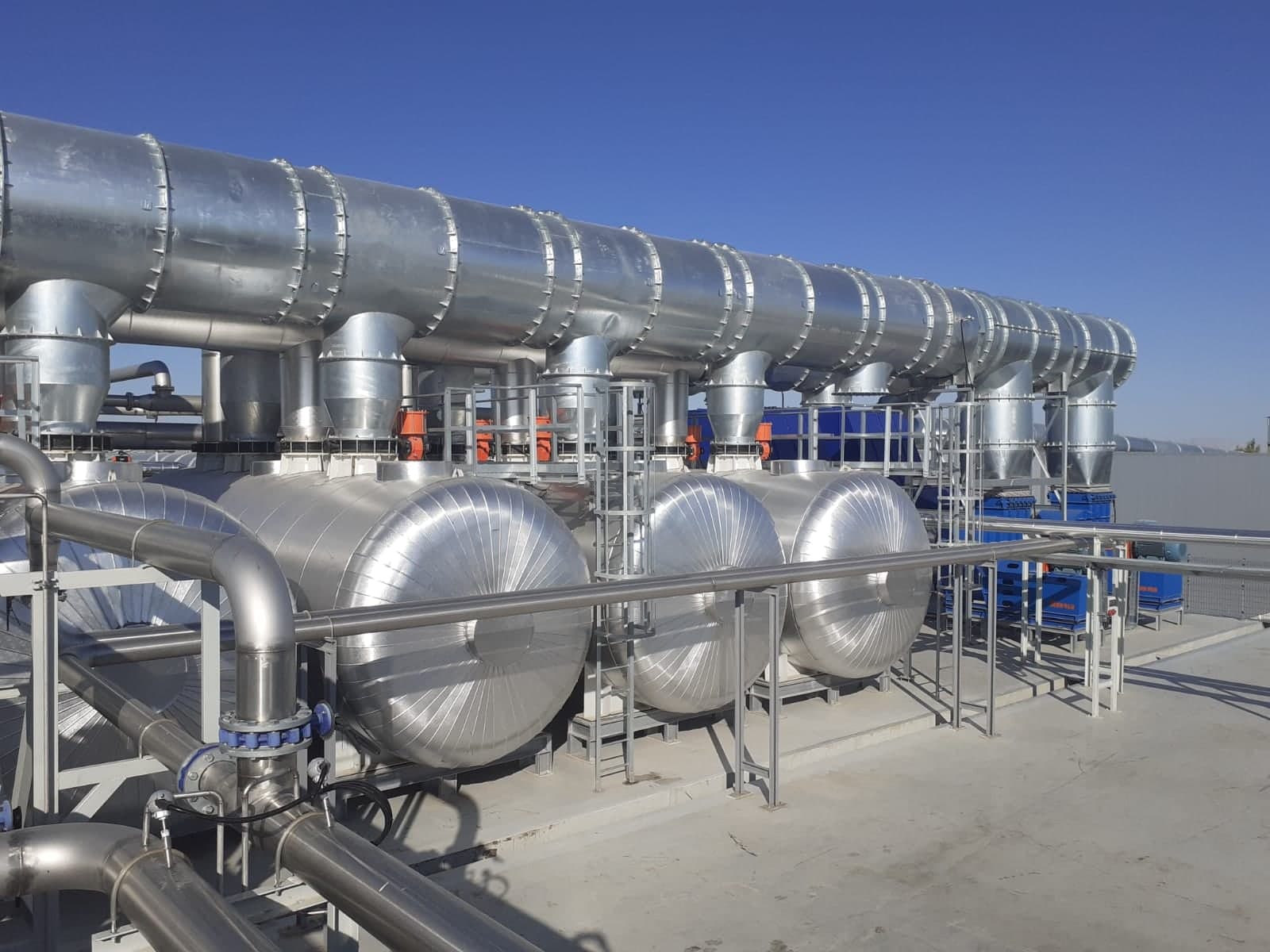
Collection and pre-treatment
The exhaust lines of the drying ovens are joined in a single header. The air is filtered to remove dust and ink particles, then cooled to a temperature suited to adsorption. Because the holding capacity of activated carbon rises as temperature falls, this step directly affects efficiency.
Adsorption
The air passes through adsorbers filled with activated carbon. The solvent molecules are held in the carbon’s microscopic pores and the cleaned air is released to the stack. The plant is built with several adsorbers: while one is being regenerated the others keep working, so the production line does not stop.
Regeneration (desorption)
The saturated bed is taken offline and heated. Heat releases the solvent from the carbon and the bed is ready for use again. The regeneration medium and cycle time are set in the project according to the solvent and whether it mixes with water.
Condensation and separation
The desorbed solvent vapour is liquefied in the condenser. Water-immiscible solvents such as toluene and hexane separate from water by themselves in the decanter.[D-01]
Purification
Water-miscible solvents such as ethyl acetate and alcohols, and multi-solvent mixtures, are separated in the distillation unit. A molecular sieve is used for water levels that distillation cannot reach.
Storage and return
The recovered solvent is transferred to nitrogen-blanketed tanks and fed back to the production line. Inside the plant the solvent circulates in a closed loop without contact with the atmosphere.
From the field
What sits where in a recovery plant?
The photograph is a site view of a plant we built. The numbers mark only equipment visible in the photograph.
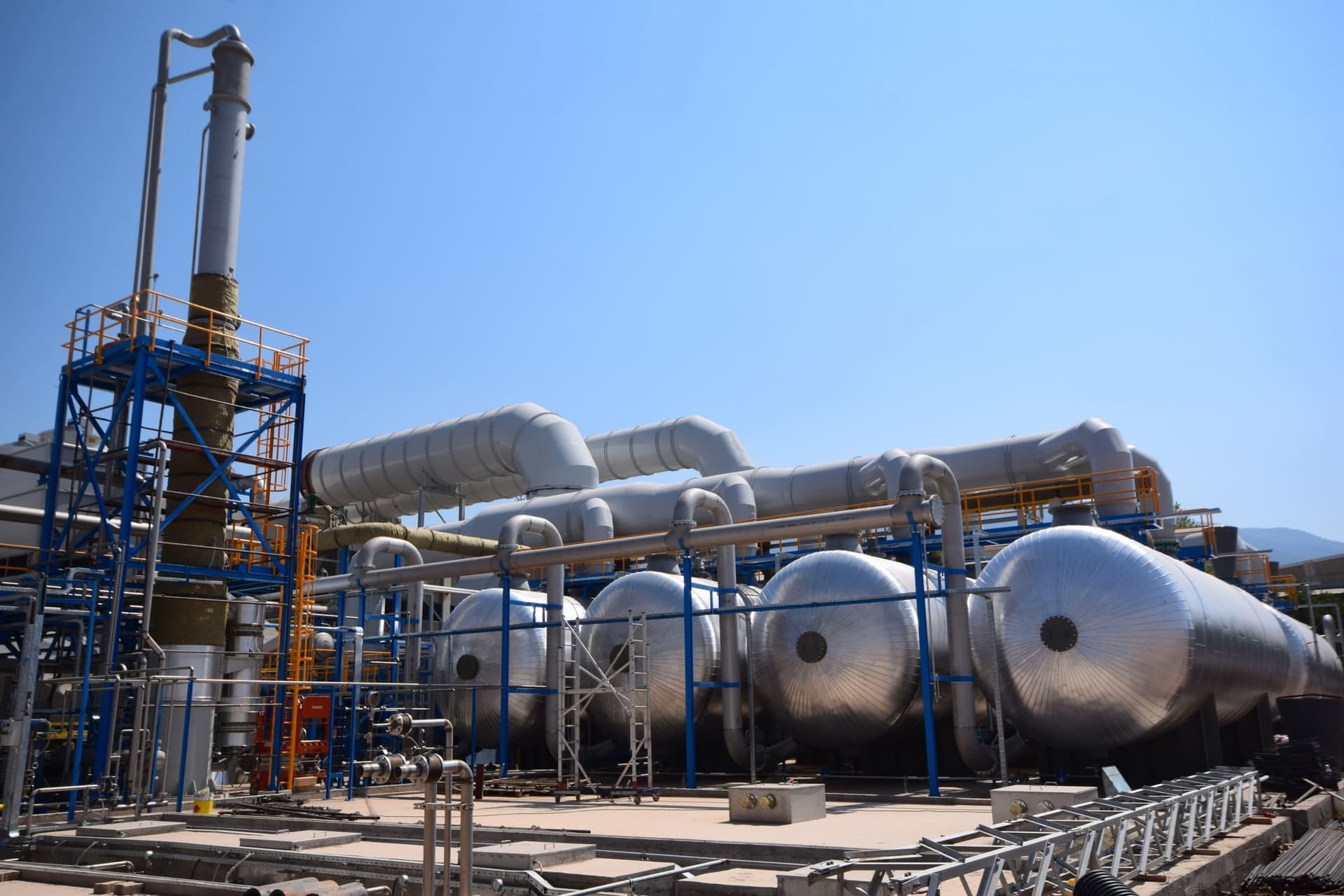
Distillation column
The column in which water-miscible or mixed solvents are separated. Details: solvent distillation unit.
Service platform and supporting steel structure
Gives access to the valves, instruments and maintenance points on the column.
Air header and ducts
Ducts that distribute the solvent-laden air from the drying ovens to the adsorbers and collect the cleaned air.
Horizontal adsorber tanks
House the activated-carbon beds. Several adsorbers work in sequence: while one is regenerated, the others keep receiving air from the line.
Thermal insulation and cladding
Reduces heat loss from the tanks heated during regeneration and limits surface temperature.
Solvent compatibility
Which solvent needs which separation step?
| Solvent | Miscibility with water | Separation after regeneration | Typical use |
|---|---|---|---|
| Toluene | Immiscible (water solubility 0.07%)[D-01] | A decanter is sufficient | Adhesive tape, coating |
| n-Hexane | Immiscible (water solubility 0.002%)[D-03] | A decanter is sufficient | Adhesive tape |
| Ethyl acetate | Partly miscible (water solubility 10%)[D-02] | Distillation and molecular sieve | Rotogravure and flexo printing, lamination |
| Ethanol, isopropyl alcohol | Fully miscible | Distillation and molecular sieve | Flexo printing, lamination |
| MEK and similar ketones | Partly miscible | Distillation; bed temperature monitoring | Coating, lacquer |
| Multi-solvent mixtures | Depends on composition | Separation into components in the distillation column | Multi-colour printing lines |
Carbon type, bed size and regeneration method are chosen in every project after solvent analysis and air measurement.
Sectors
For operations that produce solvent-laden air continuously
Carbon adsorption is a suitable emission control solution for operations that use valuable solvents and produce solvent-laden air continuously[C-01].
- 01
Flexible packaging, rotogravure and flexo printing
The exhaust of the printing and laminating dryers is collected in one header. Because the solvent arrives as a mixture, the line includes distillation and drying steps.
Typical solvents: Ethyl acetate, ethanol, isopropyl alcohol
- 02
Adhesive tape manufacturing
Almost all of the solvent on the coating line evaporates in the oven. Because water-immiscible solvents separate in the decanter, the line is simple.
Typical solvents: Toluene, hexane
- 03
Film, foil and paper coating
On lacquer and coating lines the air flow and solvent load change with the product; the plant is sized for the highest-load scenario.
Typical solvents: Toluene, MEK, ethyl acetate
- 04
Synthetic leather, rubber and bitumen coating
Solvent recovery in coating and drying processes; pre-separation may be needed depending on the mixture.
Typical solvents: Process-specific
- 05
Chemicals and pharmaceuticals
Recovery of solvent from reactor and dryer vents; the purity requirement drives the distillation design.
Typical solvents: Process-specific
- 06
Electronics and battery manufacturing
Capture of the solvents used in coating and drying steps.
Typical solvents: Process-specific
Design
The inputs that set the plant’s size and cost
A solvent recovery plant is not picked from a catalogue. Two factories with the same production capacity can need very different plants because their exhaust arrangements differ. The design rests on on-site measurement and solvent analysis.
The two most decisive quantities are air flow and solvent concentration. The less air carries a given amount of solvent, the smaller the adsorbers, fans and ducts become. That is why the dryers’ exhaust arrangement is examined before the plant is designed; if the concentration can be raised safely with an L.E.L. control unit, investment and operating cost fall together.
- Air flow and temperature: for each dryer separately, at peak and average load.
- Solvent load and composition: hourly consumption, mixture ratios, fluctuation between product changes.
- Humidity and particulates: affect carbon capacity and pre-filter selection.
- Operating pattern: number of shifts, frequency of stops; sets the regeneration cycle.
- Utilities: whether steam, cooling water, nitrogen and compressed air are available and sufficient.
- Layout: roof, yard or indoors; supporting structure, access and hazardous-area zones.
- Target purity and emission: where the recovered solvent will be used, and the limit value in your environmental permit.
Estimate
The raw-material value of the solvent going up the stack
See roughly what the recoverable solvent is worth per year, with your own consumption and price data. The real feasibility study is prepared with values measured during the survey.
Theoretical estimate
The result appears here once you fill the fields with your own data. No example or default values are shown.
This calculation is not an offer or a definitive engineering result. It is only the product of the values you entered. Investment cost, energy and maintenance, and the recovery rate actually achievable are not included, which is why no payback period is given. Those are determined after on-site measurement and process design.
Regulation
Emission limits: the current framework
In the European Union, emissions from solvent-using installations were long governed by Directive 1999/13/EC. That directive was repealed on 7 January 2014 and replaced by the Industrial Emissions Directive.[R-01] The directive was amended again in 2024.[R-02] For installations that treat surfaces with organic solvents, such as printing and coating, the best available techniques and their associated emission levels are defined in a separate implementing decision.[R-03]
Germany’s technical instruction on air quality, TA Luft, was also renewed in 2021; the 2002 version was replaced by the text that entered into force on 1 December 2021.[R-05] Our older catalogues cite 1999/13/EC and TA Luft 2002; current projects are based on the texts above.
In Türkiye, air emissions from industrial plants are subject to a permit under the Regulation on the Control of Industrial Air Pollution.[R-06] The Regulation on the Management of Industrial Emissions, which introduces the best-available-techniques approach, was published on 14 January 2025 and entered into force on 1 December 2025.[R-07] The limit value that applies to your plant depends on your activity and permit conditions. We settle the design target together with your environmental consultant.
Field evidence
Examples from the plants we built
Toluene, hexane and solvent recovery plants we built for adhesive tape, flexible packaging and polyester manufacturers. The full list is on the reference projects page.
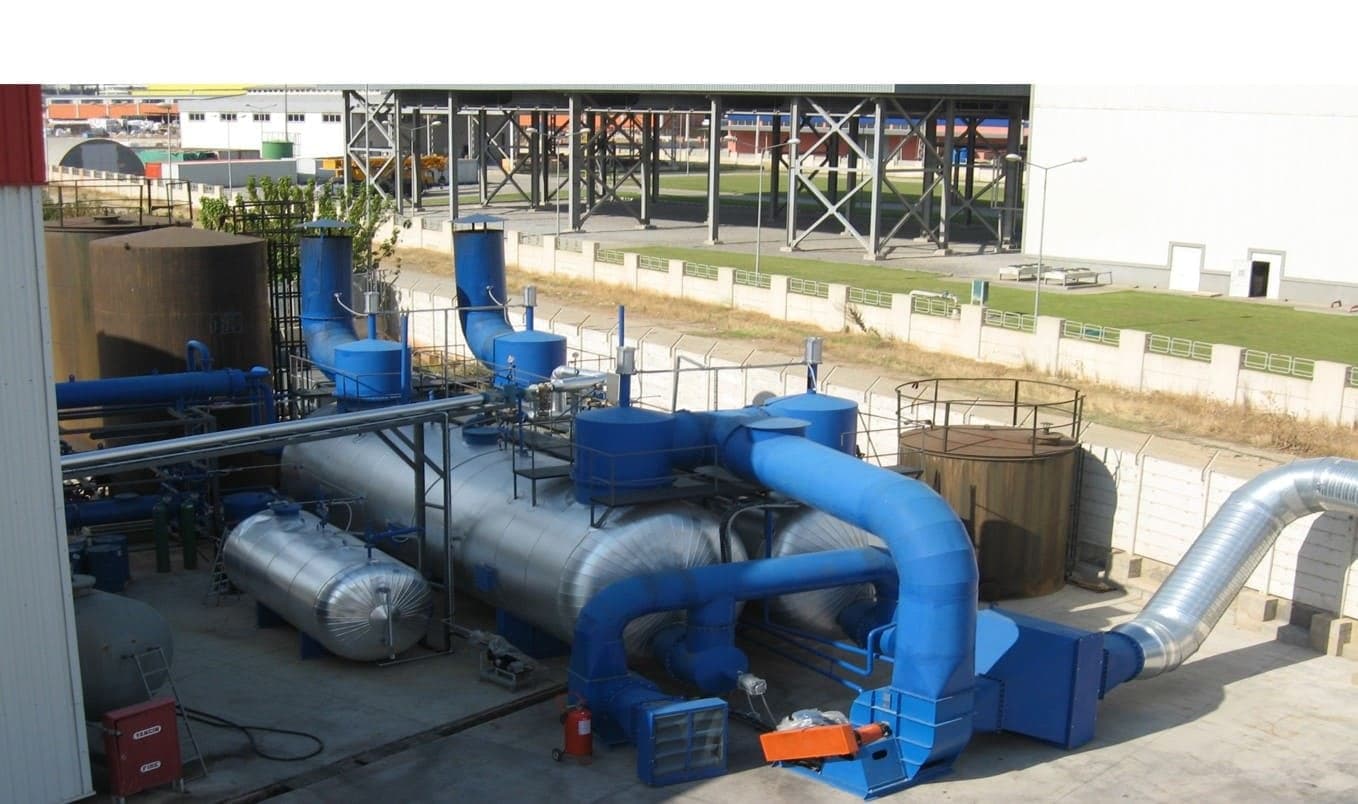
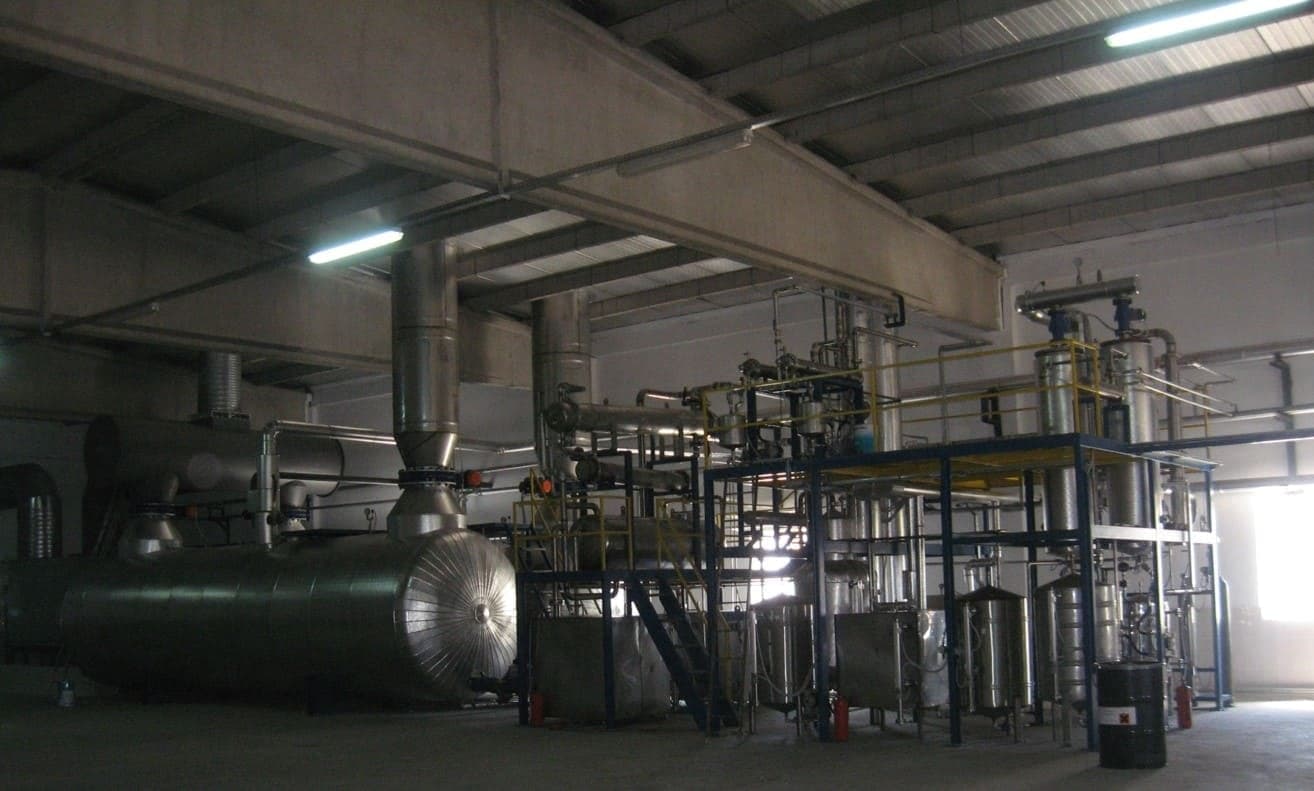
VE-GE Bant – Toluene and Hexane Recovery Plant
- Sector
- Adhesive tape
- Solvent
- Toluene, Hexane
- System
- V.O.C. solvent recovery plant
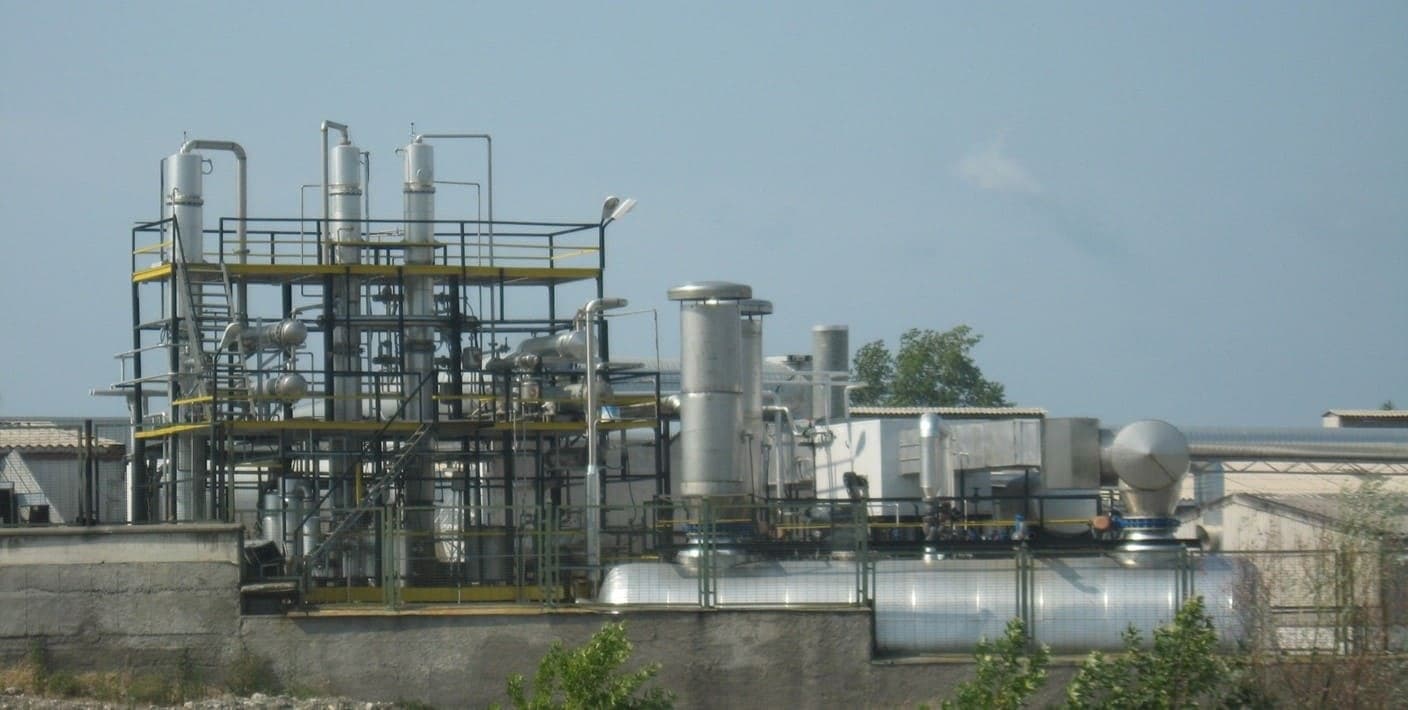
Atak Ambalaj – Karaman Solvent Recovery Plant
- Sector
- Packaging
- Location
- Karaman
- System
- V.O.C. solvent recovery plant
Barteks – Sinop Polyester Solvent Recovery Plant
- Sector
- Polyester
- Location
- Sinop
- System
- V.O.C. solvent recovery plant
Selection criteria
The price of wrong sizing and the wrong method
- DurumIf the plant is sized from the existing fan data without examining the exhaust flow
- The plant is built larger than necessary. Dryers usually run with more air than they need; flow optimisation should come first.
- DurumIf no purification step is planned for a water-miscible solvent
- The recovered solvent contains water and cannot be used in printing. The distillation and drying step has to be designed in from the start.
- DurumIf the carbon type is not chosen for the solvent
- Holding capacity stays low, regeneration becomes more frequent and energy consumption rises.
- DurumIf the solvent has little value, or is multi-component and uneconomic to separate
- Oxidation may be the better choice instead of recovery. We say so clearly at the feasibility stage.
- DurumIf the solvent composition changes often between products
- The plant is designed for the most demanding mixture; the distillation column is sized for component separation.
Project process
From survey to after commissioning
On-site survey and measurement
The line is inspected, exhaust flows and temperatures are measured, and solvent consumption and composition are recorded.
Process design and feasibility
The number of adsorbers, the carbon quantity, and the regeneration and purification line are defined. The recoverable solvent quantity and the return on investment are calculated with your plant’s own data.
Manufacturing
Tanks, adsorbers, columns and piping are built at our facility in Kemalpaşa. The automation panel and software are prepared by our own team.
Site installation and commissioning
Installation is planned to keep production downtime to a minimum. During commissioning the plant is tuned under real load.
Training, maintenance and technical support
Operators and maintenance staff are trained. Maintenance, repair, spare parts and technical support continue afterwards.
Frequently asked questions
Frequently asked questions about V.O.C. solvent recovery plants
What is a solvent recovery plant?
A solvent recovery plant is a process plant that captures the volatile organic compounds in the solvent-laden air leaving production lines on activated carbon and returns the solvent as liquid by heating the bed. Stack emissions fall and the solvent is used in production again.
Which solvents can be recovered with activated carbon?
Toluene, hexane, ethyl acetate, ethanol, isopropyl alcohol, MEK and many other industrial solvents can be recovered by activated-carbon adsorption. The carbon type and regeneration method are chosen in the project according to the solvent.
What is the emission value at the plant outlet?
In Yeşil Çevre Makine plants the design target for solvent in the outlet air is below 50 mg/Nm³. This is a company statement. The limit value and measurement conditions that apply to your plant are set separately in the project according to your environmental permit.
How quickly does the investment pay back?
The payback period depends on annual solvent consumption, the solvent’s unit price, operating hours and energy cost. A general figure would be misleading. After the survey we prepare a feasibility study with your plant’s own data.
Can the recovered solvent be reused in production?
Water-immiscible solvents are fed back to production after the decanter; water-miscible solvents and mixtures after purification by distillation and molecular sieve. The purity that is sufficient depends on your product; the target purity is agreed with you at the design stage.
Can the plant be installed on an existing production line?
Yes. The plants are designed to connect to the exhaust lines of existing drying ovens, as modular package units or site-erected plants depending on the layout. Installation is planned to keep production downtime to a minimum.
Sources and method
What the information on this page rests on
This page was prepared by Yeşil Çevre Makine using the company’s product catalogue, photographs from its site installations and the public sources listed below. Information that is a company statement is marked as such in the text. Project-specific values (capacity, emission, recovered quantity) are determined for each plant at the survey and design stage.
Values that vary by project
- Emission limit value and measurement conditions: according to your environmental permit.
- Number of adsorbers, carbon type and quantity, regeneration method: according to air measurement and solvent analysis.
- Target solvent purity: according to the product the recovered solvent will be used in.
- Recovered quantity and return on investment: according to your plant’s own consumption, price and operating-hour data.
Official regulation and standards
Primary sources; links go to the official publication pages.
- R-01Directive 2010/75/EU on industrial emissions (konsolide metin, 4 Ağustos 2024)Avrupa Birliği, EUR-Lex · 24 Kasım 2010; konsolide 4 Ağustos 2024 · Accessed: 18 Eylül 2026 · 1999/13/EC sayılı solvent emisyon direktifini 7 Ocak 2014 itibarıyla yürürlükten kaldırmıştır
- R-02Directive (EU) 2024/1785 (Endüstriyel Emisyonlar Direktifi değişikliği)Avrupa Birliği, EUR-Lex · 24 Nisan 2024; yürürlük 4 Ağustos 2024 · Accessed: 18 Eylül 2026
- R-03Commission Implementing Decision (EU) 2020/2009: organik solventlerle yüzey işlem için MET (BAT) sonuçlarıAvrupa Komisyonu, EUR-Lex · 22 Haziran 2020; Resmî Gazete 9 Aralık 2020 · Accessed: 18 Eylül 2026
- R-04Best Available Techniques (BAT) Reference Document on Surface Treatment Using Organic Solvents (STS BREF)Avrupa Komisyonu Ortak Araştırma Merkezi (JRC) · 2020 · Accessed: 18 Eylül 2026
- R-05Neufassung der Ersten Allgemeinen Verwaltungsvorschrift zum Bundes-Immissionsschutzgesetz (TA Luft 2021)Almanya Federal Çevre Bakanlığı · Yürürlük 1 Aralık 2021 · Accessed: 18 Eylül 2026 · TA Luft 2002'nin yerini almıştır
- R-06Sanayi Kaynaklı Hava Kirliliğinin Kontrolü YönetmeliğiT.C. Çevre, Şehircilik ve İklim Değişikliği Bakanlığı, Mevzuat Bilgi Sistemi · Resmî Gazete 3 Temmuz 2009, sayı 27277 · Accessed: 18 Eylül 2026
- R-07Endüstriyel Emisyonların Yönetimi YönetmeliğiT.C. Çevre, Şehircilik ve İklim Değişikliği Bakanlığı · Resmî Gazete 14 Ocak 2025, sayı 32782; yürürlük 1 Aralık 2025 · Accessed: 18 Eylül 2026
Technical reference data
Public data sources used for solvent properties.
- D-01NIOSH Pocket Guide to Chemical Hazards: TolueneABD Hastalık Kontrol ve Korunma Merkezleri (CDC), NIOSH · Son gözden geçirme 30 Ekim 2019 · Accessed: 18 Eylül 2026
- D-02NIOSH Pocket Guide to Chemical Hazards: Ethyl acetateCDC, NIOSH · Son gözden geçirme 30 Ekim 2019 · Accessed: 18 Eylül 2026
- D-03NIOSH Pocket Guide to Chemical Hazards: n-HexaneCDC, NIOSH · Son gözden geçirme 30 Ekim 2019 · Accessed: 18 Eylül 2026
Company statements and documents
Statements resting on these sources are Yeşil Çevre Makine’s own; they have not been verified by an independent body.
- C-01V.O.C. Solvent Geri Kazanım Tesisleri kataloğu (Türkçe)Yeşil Çevre Makine · 2022 · Accessed: 18 Eylül 2026 · Şirket belgesi
Request a site survey and pre-feasibility for your line
Tell us the solvent, the approximate consumption and the line. Our engineers call you to clarify the need and, where useful, plan on-site measurements.
What we ask for
- Solvent type
- Consumption or air flow
- Sector and line type
- Project stage
To reach us directly: +90 506 839 88 57 · info@yesilcevmak.com